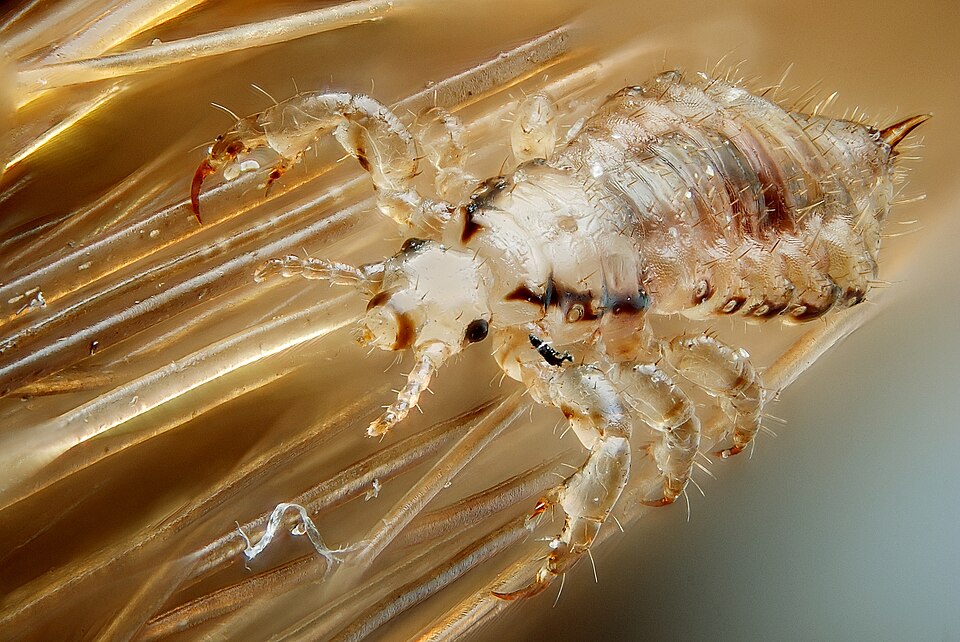
Image description: a male human head louse on a strand of hair is magnified and shown in shades of brown and orange.
Still wearing winter hats? Help prevent the spread of head lice in Hamilton County by keeping your hats and other gear for your own use.
Head lice, or Pediculus humanus capitis, are parasitic insects that feed on human blood and live primarily on the scalp. As shown in Hamilton County Public Health’s fact sheet about head lice, the insects mostly spread through head-to-head contact or by sharing items that touch the head, such as hats and earmuffs.
How do you know if you have head lice?
Head lice don’t transmit disease, but they are often itchy and uncomfortable, sometimes for a prolonged time. Common signs of head lice:
• itchy scalp or neck caused by an allergic reaction to lice bites
• tickling or crawling sensation on the scalp or in the hair
• irritability and sleeplessness
• sores on the scalp caused by scratching, which may become infected
How common are head lice?
Dealing with head lice can be agitating, but it isn’t related to personal hygiene or cleanliness.
“It’s so common that nearly every household deals with head lice at some point, including my own,” says Dr. Stephen Feagins, medical director for Hamilton County Public Health.
Feagins says that head lice activity has been strong in Hamilton County this winter, particularly in schools. “Anybody can get a head lice infestation, including adults,” Feagins says. “But it’s especially common for children, who often play or study closely together and share hats, clothing and soft accessories.”
Feagins adds that schools can become overwhelmed with head lice infestations because the insects can live on the scalp for about 30 days and multiply quickly. After discovery, students are permitted to return to school once they apply an over-the-counter or prescription medication treatment to the scalp, but some families opt to keep kids home longer to apply additional treatment and wash head-adjacent items like bedding and stuffed animals.
“For some families, head lice can mean significant time away from school, so the best treatment is actually prevention,” Feagins says. “Students can reduce their chances of getting lice and see more time in the classroom by maintaining a little distance and not sharing their hats, hair accessories, scarves or jackets with their friends.”
How can you prevent head lice?
You can help prevent the spread of head lice in Hamilton County by taking a few easy steps:
• Avoid head-to-head (or hair-to-hair) contact during play and other activities.
• Do not share combs, brushes, towels, hats, scarves, coats, sports uniforms or hair accessories.
• Routinely and thoroughly check all household members for head lice in a brightly lit room.
• Treat lice with over-the-counter or prescription shampoos and other approved medications.
• Talk to your doctor or school nurse about additional measures.
To learn more, download Hamilton County Public Health’s fact sheet about dealing with head lice.